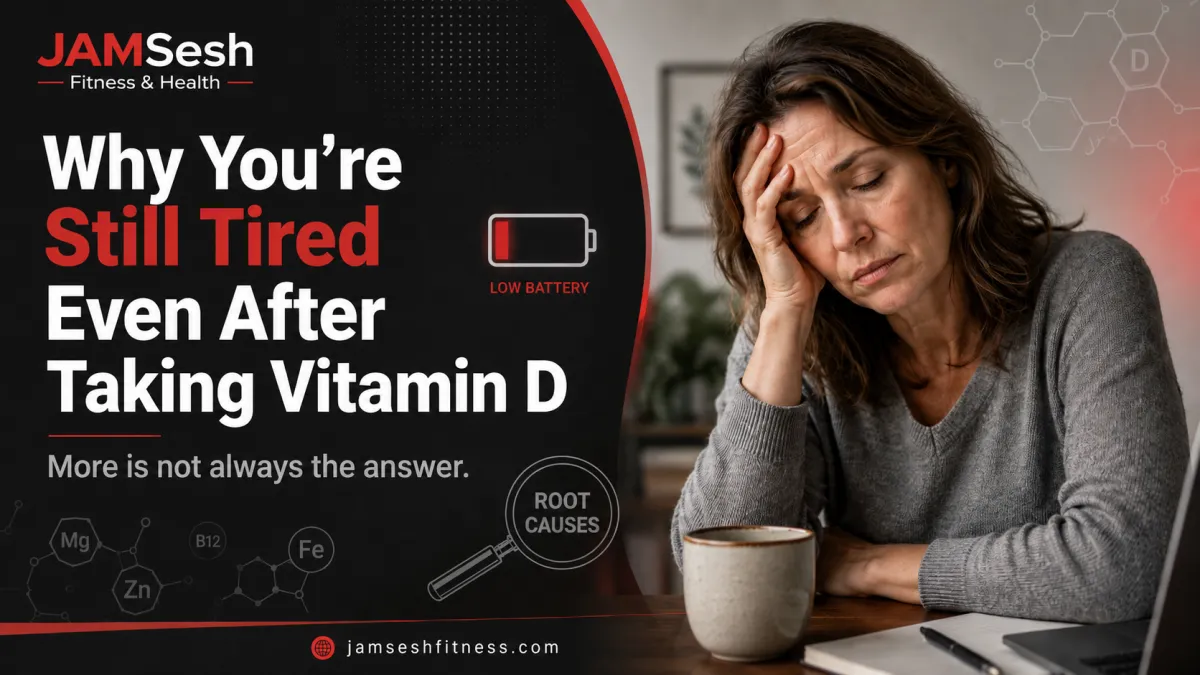
Doctor Said Your Vitamin D Is Low? Read This Before Taking More

You’re exhausted.
Not just “I stayed up too late” tired.
I mean the kind of tired where you wake up already behind, stare at your coffee like it owes you money, and wonder why your body still feels like it is running on low battery mode no matter what you do.
So you get bloodwork done, or maybe you already had it checked, and someone says:
And honestly, that sounds like it should make sense.
Vitamin D matters. It supports immune function, mood, bone health, hormone signaling, and overall wellness. So if your level is low, taking more should help you feel better, right?
Sometimes, yes.
But not always.
Because if you have been taking Vitamin D and you still feel tired, foggy, heavy, inflamed, anxious, or like your body refuses to wake up, the better question may not be:
“Do I need more Vitamin D?”
The better question may be:
“Why is my body still so tired, even when I’m trying to do the right things?”
That is where this conversation gets more useful.
Fatigue is rarely a one-supplement problem. And more Vitamin D is not the answer for everyone.
Low Vitamin D Does Not Always Explain Why You Feel So Drained
Most standard bloodwork checks 25-OH Vitamin D, which is the form of Vitamin D circulating in your blood.
If it comes back low, the most common next step is simple: take Vitamin D.
That can be helpful for some people, especially when levels are truly low and the body is able to use it well.
But a low Vitamin D number does not automatically explain why you feel exhausted. It also does not always tell us why your body is struggling to maintain healthy Vitamin D levels in the first place.
Bloodwork can show what is circulating in the blood. That is valuable. But fatigue is usually bigger than one lab marker
So yes, your Vitamin D may be low.
But that does not always mean Vitamin D is the main reason you are tired.
Sometimes low Vitamin D is less of a final answer and more of a clue that your body is under stress.
Not sure what your symptoms are trying to tell you?
Start simple. My symptom quiz can help you connect the dots between fatigue, stress, cravings, sleep, digestion, and the patterns your body may be showing.
Vitamin D Has a Job, and That Job Requires Support

One of Vitamin D’s major jobs is helping your body absorb calcium.
That can be a good thing when the body is balanced and actually needs that support.
But if the body is already stressed, depleted, inflamed, or struggling to regulate calcium properly, adding more Vitamin D may not create the energy shift you are hoping for.
Vitamin D is not a stand-alone energy button. It is part of a whole system.
Your body needs certain nutrients and minerals to activate Vitamin D, transport it, use it, and keep calcium in the right places.
This is one of the most overlooked pieces of the fatigue puzzle.
When you take more Vitamin D, your body may need to use more of the minerals that help process and balance it, especially magnesium. Magnesium is involved in the enzymes that help convert Vitamin D into its active form. It also helps balance calcium’s effects in the body.
So if you are already depleted, stressed, or burning through minerals faster than you can replenish them, taking more Vitamin D may place more demand on a body that is already running on fumes.
This does not mean Vitamin D is bad.
It does not mean you should never supplement.
It means the answer depends on the person, the pattern, the dose, the timing, and what else is happening in the body.
The goal is not just to push a lab number higher. The goal is to understand why your body feels tired in the first place.
What If Your Body Feels Tired Because It Is Stuck in Protection Mode?
When the body is under chronic stress, it often does not prioritize energy, metabolism, digestion, or repair the way we want it to.
Instead, it may shift into a slower, more protective state.
This is where you can feel like you are doing “all the things” and still not getting anywhere.
This can feel like waking up tired, needing caffeine to function, afternoon crashes, brain fog, heavy limbs, low motivation, cravings, poor stress tolerance, or feeling like your body is just not responding.
When someone feels like this, they often start adding more supplements.
More Vitamin D. More B12. More iron. More adrenal support. More greens powders. More “energy” formulas.
But if the body is not using nutrients well, more is not always better.
Sometimes fatigue is not your body asking for more things. Sometimes it is asking for the right things in the right order.
Vitamin D and Calcium Are Connected
This is where Vitamin D can get tricky for some people.
Because Vitamin D helps increase calcium absorption, we also want to ask: how is your body handling calcium?
Calcium is important. But calcium needs to be used properly. It belongs in the right places, doing the right jobs.
When calcium is not being regulated well, the body can feel more slow, stiff, heavy, tense, or shut down.
That is one reason I do not love the blanket advice of “just take more Vitamin D” for every tired person with low Vitamin D on bloodwork.
The issue may not be that you need to force more in. The issue may be that your body needs help using and regulating what it already has.
This is where minerals matter, but you do not need to become a mineral balancing expert to understand the point.
Your minerals help your body make energy, respond to stress, support thyroid function, regulate fluids, calm the nervous system, support digestion, and use nutrients like Vitamin D properly.
If those patterns are off, your energy can feel off too.
“But My Doctor Said My Vitamin D Is Low”
Your doctor may be right.
Your Vitamin D may truly be low.
The problem is not the lab result. The problem is assuming that one result explains the whole fatigue story.
Bloodwork can ask: how much Vitamin D is in the blood?
A deeper look asks: why is your body still tired?
Both matter.
But if you are tired, depleted, inflamed, and not improving despite supplementing, it may be time to stop treating fatigue like a simple “low Vitamin D” problem.
The goal is not to chase one number. The goal is to understand the body behind the number.
If You’re Tired, You Need Better Clues
This is where so many people get stuck.
They are trying. They are buying the supplements. They are listening to podcasts. They are drinking the water, taking the capsules, cutting the sugar, walking more, sleeping more, and still feeling like their body did not get the memo.
That does not mean you are broken. It means your body may need a more strategic approach.
Fatigue is often your body waving a little white flag saying:
“I need support, but please stop guessing.”
That is where testing can be so helpful.
Not because you need another overwhelming pile of numbers.
Because you need a clearer picture of what your body is actually asking for.
This is where HTMA testing can be a powerful next step. HTMA stands for Hair Tissue Mineral Analysis. It gives us a longer-term look at mineral patterns and stress trends in the body.
Instead of guessing which supplement to add next, we can look at whether your body is showing patterns connected to stress, low energy, slow metabolism, poor mineral regulation, or nutrient depletion.
That does not replace bloodwork. It adds another layer of information.
The Bottom Line
If you are still tired even after taking Vitamin D, more Vitamin D may not be the answer.
Your body may be asking for a deeper look at stress, nutrient use, energy patterns, digestion, inflammation, and mineral balance.
Fatigue is not always a simple deficiency problem.
Sometimes it is a regulation problem.
And when your body is tired, overwhelmed, and stuck, the answer is not always to push harder or add more.
Sometimes the answer is to stop guessing and finally listen to what your body has been trying to tell you.
Disclaimer
This information is educational and is not a diagnosis or a replacement for medical care. Always work with your qualified healthcare provider before changing supplements, especially if you are pregnant, nursing, have kidney disease, hyperparathyroidism, sarcoidosis, high blood calcium, are taking medications, or have been advised to monitor Vitamin D or calcium levels.


