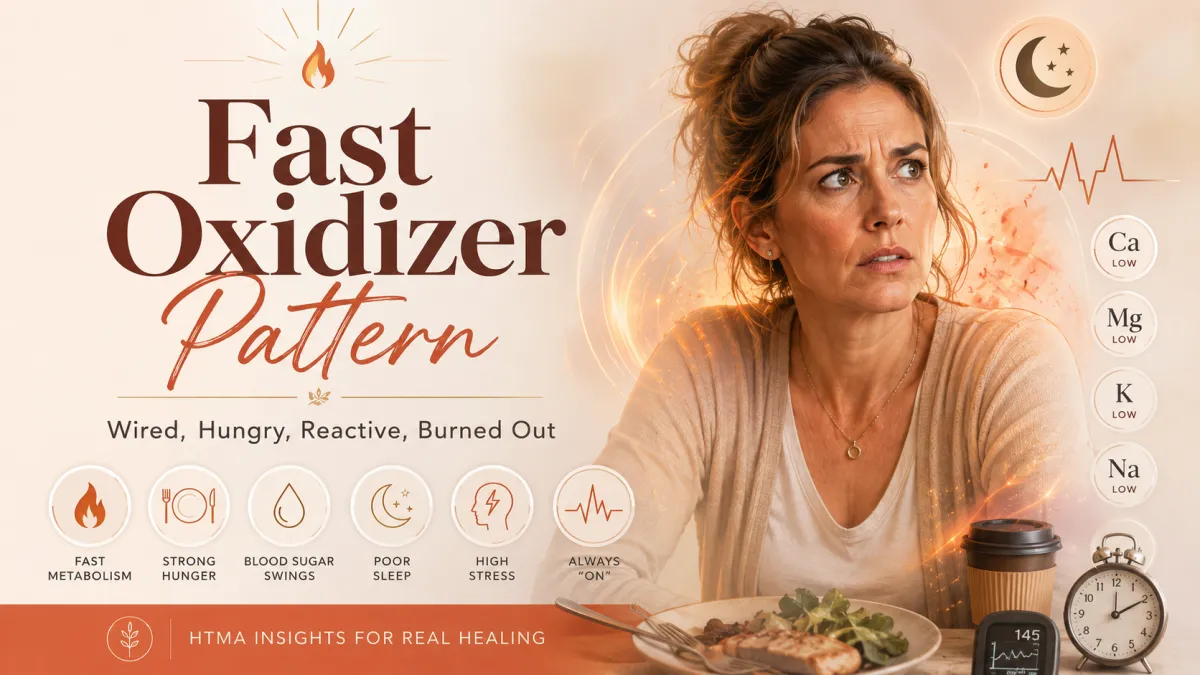
Fast Oxidizer Pattern on HTMA: Symptoms, Meaning, and Support
Your body may be burning through reserves
A fast oxidizer pattern on an HTMA can feel incredibly validating once you understand what it means.
Because if you are a fast oxidizer, you may have spent years being told you are “just anxious,” “too intense,” “too sensitive,” “too driven,” or that you “just need to calm down.”
But your body may be showing a real mineral pattern that helps explain why your internal engine feels like it runs hot.
You may say things like:
“I feel like I am always on.”
“I burn through food so fast.”
“I get shaky, irritable, or anxious if I do not eat.”
“I can push hard, but then I crash.”
“I feel wired, reactive, or overstimulated.”
“My mind runs fast and my body cannot always keep up.”
“I need caffeine, but caffeine can make me feel worse.”
“I feel inflamed, hot, tense, or restless.”
A fast oxidizer can look high-energy from the outside, but that does not mean the person feels well on the inside.
Many fast oxidizers are not running on calm, steady energy.
They are running on stress chemistry.
And that is very different.
This pattern does not mean your body is broken. It usually means your body has been living with the accelerator pressed down for a long time.
Your system may be burning through minerals, fuel, and emotional bandwidth faster than it can rebuild.
Your body is not failing.
It may be trying to survive by staying ready, alert, and reactive.
Educational note: HTMA does not diagnose disease. It is a tool that helps us understand mineral patterns, stress response, detox capacity, and how the body may be adapting over time.
What is a fast oxidizer on HTMA?
In HTMA language, a fast oxidizer is someone whose body appears to be burning fuel faster than ideal.
Oxidation simply means how your body burns or uses fuel.
A slow oxidizer tends to burn fuel slowly and conserve energy.
A fast oxidizer tends to burn fuel quickly and move into output, reaction, and stress response more easily.
In classic mineral-balancing interpretation, fast oxidation often shows up when the calcium-to-potassium ratio is low and the sodium-to-magnesium ratio is high.
In plain language, calcium and magnesium are often lower relative to sodium and potassium.
Calcium and magnesium are more calming and buffering minerals.
Sodium and potassium are more activating, adrenal, stress-response minerals.
So when the activating minerals dominate and the calming minerals are low, the person may feel like their body is running hot, fast, reactive, and under-buffered.
This is why fast oxidation is not just about having “high energy.”
For many people, it is high output with poor recovery.
Curious what your HTMA may be saying about your body?
A Hair Tissue Mineral Analysis can help us look at your mineral patterns, stress response, adrenal minerals, thyroid expression, digestion, detox capacity, and why your body may feel wired, hungry, reactive, or burned out.
The best analogy: the accelerator is stuck down
Think of your body like a car.
A slow oxidizer is like a car driving with the brakes on.
A 4 Lows person may feel like the car is on, but the wheels are not catching.
A fast oxidizer is like a car with the accelerator pressed down.
The engine is revving.
Fuel is burning.
The system is moving fast.
But that does not mean the ride feels smooth.
If the accelerator is stuck down for too long, the car overheats, burns fuel quickly, wears down parts, and becomes harder to control.
That is how many fast oxidizers feel.
They may be productive, driven, intense, quick-thinking, and capable.
But inside, they may feel like they are running on adrenaline instead of true reserve.
The goal is not to take away their energy or personality.
The goal is to help the body slow the burn so energy becomes steady instead of explosive.
How a fast oxidizer can feel physically
A fast oxidizer may feel:
hungry often
shaky if meals are delayed
anxious with hunger
wired at night
restless
tense muscles
headaches
poor sleep
quick energy followed by crashes
heat intolerance or sweating
inflammation
loose stools or urgency
palpitations or flutters
sensitive to caffeine
over-amped by intense exercise
tired but unable to fully settle
This is often the person who feels like their body changes gears too fast.
Fine one minute.
Hangry, anxious, irritable, or crashy the next.
How a fast oxidizer can feel emotionally
The emotional side of fast oxidation can be intense.
A fast oxidizer may feel:
anxious
impatient
irritable
quick to react
emotionally intense
restless
competitive
easily overstimulated
unable to slow down
guilty when resting
bored when still
driven but depleted
tired but wired
like their body is always bracing for the next thing
This does not mean you are “too much.”
It may mean your nervous system is under-buffered and overactivated.
Your body may have learned that staying ready is safer than slowing down.
If you feel wired, hungry, reactive, or burned out, your HTMA may help show whether your body is burning through reserves.
Fast oxidation is not just about having energy. For many people, it is a pattern of high output, stress chemistry, blood sugar swings, and poor recovery — and that changes how we support the body.
The four big minerals in fast oxidation
The first four major minerals on the HTMA — calcium, magnesium, sodium, and potassium — tell us so much about how the body is running.
In a classic fast oxidizer pattern, calcium and magnesium are often low relative to sodium and potassium.
This can suggest lower buffering minerals and higher activating minerals.
But this is important: high sodium and high potassium do not always mean strong reserves.
High sodium can be an alarm marker, inflammation marker, sympathetic stress marker, or a sign that the body is burning through adrenal output.
High potassium can sometimes reflect stress, catabolism, cellular turnover, irritation, or dumping rather than true stability.
So we never interpret these minerals in isolation.
We read the full HTMA pattern, symptoms, ratios, stress history, digestion, food intake, supplements, toxic metals, exercise, caffeine, fasting, and how the person actually feels.
When calcium is low in a fast oxidizer
Low calcium in a fast oxidizer can feel like the body has less of a protective buffer.
Calcium is not just a bone mineral. In HTMA interpretation, calcium is also connected to nervous system buffering, membrane stability, emotional steadiness, sleep quality, and the ability to slow down.
When calcium is low, the person may feel like they are missing a layer of protection between themselves and the world.
Physically, this can show up as:
muscle tension
cramps or twitching
poor sleep
feeling wired at night
sensitivity to noise
teeth grinding or jaw tension
hormone reactivity
feeling warm or flushed
higher stress reactivity
restlessness
Emotionally, low calcium can feel like being unbuffered.
You may feel exposed, impatient, reactive, easily irritated, or like small things hit harder than they should.
Support is not about randomly taking high-dose calcium.
It is about helping the body slow the burn and use calcium properly through calming minerals, adequate dietary minerals, healthy fats, protein, vitamin cofactors, nervous system work, and reducing constant stress outputs.
When magnesium is low in a fast oxidizer
Low magnesium is one of the biggest reasons a fast oxidizer may feel tense, restless, anxious, crampy, or unable to relax.
Magnesium is one of the body’s key relaxation, sleep, recovery, bowel, muscle, and stress-resilience minerals.
When magnesium is low, the nervous system can feel like it is holding its breath.
Physically, this can show up as:
muscle cramps
twitching
headaches
constipation or spasms
insomnia
restless legs
tight shoulders
jaw clenching
heart flutters
poor recovery after workouts
Emotionally, low magnesium can feel like inner pressure.
You may feel anxious, wound up, irritable, impatient, unable to settle, or like your body is always bracing.
Support may include gentle magnesium through food or supplementation when tolerated, but also reducing caffeine, alcohol, overtraining, chronic under-eating, and stress patterns that burn through magnesium.
Magnesium works best when the whole system is supported: protein, sodium/potassium balance, digestion, sleep rhythm, and nervous system safety.
When sodium is high in a fast oxidizer
High sodium in a fast oxidizer can look like strong adrenal output, but it does not always mean strong adrenal reserve.
This is a key distinction.
Sodium is one of the minerals we look at for stress response, adrenal output, inflammation, hydration, blood pressure tendencies, and the body’s ability to mobilize.
When sodium is high, the body may be in alarm mode.
Physically, this can show up as:
feeling hot or sweaty
higher blood pressure tendencies
inflammation
intense thirst
frequent urination
feeling revved up
headaches
waking wired
feeling worse with stimulants
being unable to fully wind down
Emotionally, high sodium can feel like fight mode.
You may feel driven, intense, impatient, reactive, irritated, frustrated, or like you cannot turn the volume down.
Support is not always about adding more salt aggressively.
We look at the whole picture. Some fast oxidizers may need sodium support if depleted, but others need to reduce stress output, inflammation, stimulants, overtraining, and detox pushing that keeps sodium elevated.
The goal is steady adrenal rhythm, not constant alarm.
When potassium is high in a fast oxidizer
High potassium in a fast oxidizer can reflect a body that is highly activated, reactive, catabolic, or burning through fuel quickly.
Potassium is connected to cellular energy, blood sugar rhythm, muscle function, adrenal stress chemistry, and how cells hold and move electrical charge.
When potassium is high in this context, it can reflect strong output, but it can also reflect loss, cellular turnover, stress, inflammation, or detox irritation.
Physically, this can show up as:
fast energy followed by crashes
blood sugar swings
shakiness if meals are delayed
muscle weakness after exertion
heart flutters
anxiety with hunger
loose stools or urgency
poor recovery
feeling worse with fasting
feeling over-amped by intense exercise
Emotionally, high potassium can feel like volatility.
Energy may spike and drop.
Mood may spike and drop.
You may feel intense, passionate, reactive, easily overwhelmed, or like your system changes gears too fast.
Support often includes stabilizing blood sugar, eating enough protein and healthy fat, reducing sugar and stimulants, matching exercise to recovery, and being careful with aggressive detox or fasting.
We want potassium to become steady and well-used — not just high because the system is stressed, inflamed, or dumping.
Why fast oxidizers can feel anxious, irritable, and reactive
Fast oxidation often reflects a stronger sympathetic stress response.
In simple terms, the body is more easily pushed into fight-or-flight.
That can be useful in short bursts.
It helps you act quickly, think fast, move fast, respond fast, and get things done.
But when that state becomes the normal setting, the body pays for it.
You may feel:
anxious
impatient
irritable
emotionally intense
reactive to noise or stress
easily overstimulated
unable to slow down
tired but wired
driven but depleted
confrontational or defensive when stressed
like your body is always scanning for the next thing
This does not mean your personality is the problem.
It means your nervous system and mineral pattern may be keeping you in a high-output state.
We do not want to erase your fire.
We want to help your body stop burning itself to keep the fire going.
True fast oxidizer vs. temporary fast oxidizer
Not all fast oxidizers are the same.
Some people are true fast oxidizers. Their system naturally tends to run faster, hotter, more outward, and more responsive to stress.
Others are temporary fast oxidizers.
That means they may look fast on the HTMA because the body is under stress, inflamed, exposed to toxins, overtraining, under-eating, detoxing too hard, drinking too much caffeine, or reacting to something.
In these cases, the fast pattern may be a stress response layered on top of deeper depletion.
This is why interpretation matters.
We ask:
Is this true vitality or alarm chemistry?
Is sodium high because the person is strong, or because they are inflamed?
Is potassium high because cells are energized, or because they are dumping?
Is the person robust, or are they anxious and crashy?
Are toxic metals, copper imbalance, or detox reactions driving the pattern?
Is the body truly thriving, or just pushing?
The pattern is not just a label.
It is a conversation with the body.
This is why I do not look at minerals as isolated numbers.
A fast oxidizer pattern can mean different things depending on your symptoms, stress history, digestion, blood sugar, hormones, toxic metals, exercise, and recovery. HTMA helps us see the full picture instead of guessing from one marker.
Tired fast oxidizers: when the body is fast but depleted
Some fast oxidizers do not feel energized at all.
They feel exhausted, but still revved.
This can happen when the body is still in a fast or sympathetic pattern, but reserve is starting to drop.
These clients may feel:
tired but wired
anxious but exhausted
hungry but nauseated
driven but depleted
inflamed but weak
sensitive to supplements
crashy after workouts
reactive to caffeine
prone to sugar cravings
more immune-sensitive
This person does not need to be pushed harder.
They need to be stabilized.
The goal is to lower the burn rate and rebuild reserve at the same time.
Blood sugar: why fast oxidizers can feel hangry
Blood sugar is a huge part of the fast oxidizer picture.
When the body burns fuel quickly, meals may not last long enough.
You may feel fine one minute and shaky the next.
This can feel like:
hanger
anxiety with hunger
sugar cravings
needing snacks
waking at night
headaches if meals are delayed
emotional reactivity before eating
feeling better after meat, fat, or a more substantial meal
feeling worse after sweets, juice, or caffeine
This is not a willpower issue.
It is a fuel-timing issue.
A fast oxidizer body often needs meals that burn slowly.
That usually means enough protein, healthy fat, minerals, and carbohydrates chosen carefully so they stabilize instead of spike.
Food should not create a spike, crash, and panic cycle.
Food should help the body feel grounded.
This is why fast oxidizer support starts with stabilization.
Before pushing detox, harder workouts, or more supplements, we want to calm the burn rate, stabilize blood sugar, rebuild mineral buffers, and help your body stop running on adrenaline.
Copper, zinc, and fast oxidation
Copper and zinc can be very important in fast oxidizers.
In some fast oxidizer patterns, copper may be low, unavailable, or being burned through due to adrenal and thyroid stress chemistry.
Copper helps with many functions, including connective tissue, nervous system regulation, iron handling, pigmentation, antioxidant enzymes, and mineral balance.
But copper is also complex.
It can be low, high, hidden, unavailable, poorly transported, or dysregulated.
That is why we do not interpret copper from one number alone.
We look at copper, zinc-to-copper, copper-to-molybdenum, sodium-to-potassium, sodium-to-magnesium, calcium-to-potassium, iron-to-copper, symptoms, hormones, histamine signs, toxic metals, and the client’s sensitivity.
Copper imbalance can overlap with:
anxiety
mood swings
irritability
PMS
histamine symptoms
headaches
racing thoughts
fatigue
low motivation
immune reactivity
connective tissue issues
Fast oxidizers may sometimes need copper support, but not always and not blindly.
The goal is copper regulation.
We do not want to push copper aggressively into someone who is reactive, inflamed, or already showing copper dysregulation.
We also do not want to use high-dose zinc without considering copper, adrenal reserve, and the full HTMA picture.
This is where a conservative, individualized plan matters.
Detox in a fast oxidizer: slow the fire before stirring the ashes
Fast oxidizers can be tempted by intense detox because they often like action.
They may think, “Let’s just get this out.”
But aggressive detox can backfire if the body is already inflamed, reactive, depleted, or burning through minerals.
Detox takes minerals.
Detox takes protein.
Detox takes bile flow.
Detox takes bowel movements.
Detox takes nervous system capacity.
If a fast oxidizer pushes detox too hard, it may feel like throwing gasoline on a fire.
This can show up as:
anxiety
insomnia
headaches
irritability
histamine flares
skin flares
loose stools or constipation
nausea
heart flutters
fatigue crashes
emotional volatility
The goal in Phase 1 is not aggressive mobilization.
The goal is stabilization.
Blood sugar first.
Minerals first.
Bowels first.
Sleep first.
Nervous system first.
Then detox can happen more smoothly, without making the person feel like their body is on fire.
Why fast oxidizers may struggle with weight too
There is a misconception that fast oxidizers are always thin.
Some are.
But not all.
A fast oxidizer can also gain weight, especially around the upper body, abdomen, chest, back, or midsection, depending on stress hormones, blood sugar, inflammation, and lifestyle.
When the body is in chronic stress chemistry, it may burn through minerals but still hold fat.
This is especially true if the person is sleeping poorly, drinking caffeine, skipping meals, overtraining, under-eating, relying on sugar, or living in a constant cortisol/adrenaline loop.
So again, weight is not just calories.
It is chemistry.
A fast oxidizer often needs to stabilize blood sugar, calm inflammation, support minerals, reduce stimulants, improve sleep, and stop training from a place of punishment before body composition work becomes more responsive.
Phase 1 support for a fast oxidizer
Phase 1 is about slowing the burn rate and rebuilding buffers.
Not sedating the person.
Not taking away their drive.
Not forcing extreme detox.
The main goal is to help the body feel steady enough to stop burning through reserves.
1. Blood sugar stability
Fast oxidizers often need meals that last.
That means enough protein, healthy fat, minerals, and slower-burning carbohydrates instead of quick sugar hits.
The goal is fewer spikes, fewer crashes, and less hanger.
2. Calming mineral support
Calcium and magnesium are key buffering minerals in this pattern.
The support depends on the full HTMA, symptoms, and tolerance, but the goal is often to help the body feel less raw, less reactive, and less easily pushed into stress chemistry.
3. Adrenal rhythm support
High adrenal output does not always mean strong adrenal reserve.
We support rhythm: morning light, steady meals, sleep consistency, mineral hydration, less caffeine dependence, and recovery after stress.
4. Digestive steadiness
Fast digestion or reactive digestion may need calming support.
Meals should be substantial enough to hold energy steady without feeling heavy or inflammatory.
5. Nervous system regulation
Fast oxidizers often need practices that discharge stress without adding more stress.
Walking, breathwork, downshifting after work, boundaries, less multitasking, and actual rest can be part of the plan.
6. Copper and trace mineral regulation
Fast oxidizers may need support around copper, zinc, vitamin A, selenium, manganese, molybdenum, and other trace minerals — but the key is context.
We support regulation, not random high-dose pushing.
7. Gentle detox and inflammation support
First calm the fire.
Then detox can move better.
Drainage, bowels, hydration, minerals, protein, and sleep come before aggressive mobilization.
A fast oxidizer usually needs stabilization before intensity.
HTMA can help identify which foundations need support first — blood sugar, minerals, adrenal rhythm, digestion, copper balance, detox drainage, nervous system regulation, or recovery.
Food guidance for fast oxidizers
Food for fast oxidizers should be grounding, steady, mineral-rich, and slower-burning.
The goal is not to overstimulate an already fast system.
The goal is to give the body fuel that lasts.
Foods to emphasize
protein at each meal
healthy fats with meals if tolerated
eggs, meat, poultry, fish, lamb, beef, turkey, or other tolerated proteins
root vegetables, potatoes, squash, rice, oats, or other slower carbohydrates based on tolerance
cooked vegetables
mineral-rich broths or soups
calcium-rich foods if tolerated
magnesium-rich foods if tolerated
meals that feel grounding and substantial, not airy or snacky
Foods and habits to reduce or be careful with
skipping meals
long fasting windows
very low-fat dieting
very low-calorie dieting
excess caffeine
caffeine on an empty stomach
sugar, sweets, fruit juice, and refined carbs
alcohol as a downshift tool
overdoing spicy or stimulating foods if already inflamed
hard training without enough food
aggressive detox or cleanses
Many fast oxidizers do better when they stop trying to live on coffee, salad, protein bars, and willpower.
They often need real meals.
Meals that say:
“You are safe. You are fed. You do not have to run on adrenaline.”
Movement guidance for fast oxidizers
Fast oxidizers often love intensity.
They may be naturally competitive, driven, powerful, or drawn to hard workouts.
That can be a gift.
But it can also become a drain if recovery is not there.
A fast oxidizer may feel amazing during a workout because stress chemistry is high, then crash later.
They may use exercise to regulate anxiety, but if the dose is too high, it can worsen the mineral pattern.
In Phase 1, movement should build resilience, not just burn energy.
Helpful options may include:
strength training with good rest periods
walking
mobility
Pilates-style control work
zone 2 cardio if tolerated
short conditioning instead of long punishment sessions
grounding recovery after workouts
more protein and minerals around training
Be careful with:
excessive HIIT
fasted hard training
daily intense workouts
using caffeine to force performance
under-eating after training
ignoring poor sleep and still pushing hard
A helpful question is:
“Did this workout make me more regulated, or more depleted?”
The goal is not to kill the fire.
The goal is to teach the fire to burn clean.
Frequently asked questions about fast oxidation
Is fast oxidation the same as anxiety?
No. HTMA does not diagnose anxiety. But a fast oxidizer pattern can overlap with a more activated, sympathetic, under-buffered state that may feel like anxiety, irritability, restlessness, or being unable to slow down.
Are fast oxidizers always thin?
No. Some are, but not all. A fast oxidizer can also gain weight, especially when chronic stress chemistry, poor sleep, blood sugar swings, inflammation, caffeine, and overtraining are involved.
Should fast oxidizers avoid carbs?
Not necessarily. Many fast oxidizers do poorly with very low-carb dieting because they burn through fuel quickly. The goal is usually steady, slower-burning meals with protein, fat, minerals, and appropriate carbohydrates.
Why do fast oxidizers feel worse with caffeine?
Caffeine can push an already activated system harder. Some fast oxidizers feel temporarily better with caffeine, but then experience more anxiety, irritability, insomnia, blood sugar swings, or crashes later.
Should fast oxidizers detox?
Usually gently. If the body is already inflamed, reactive, anxious, or depleted, aggressive detox can make symptoms worse. Stabilization comes first.
Can a fast oxidizer pattern improve?
Yes. Fast oxidation can shift with consistent support around blood sugar, minerals, digestion, sleep, recovery, nervous system regulation, and a detox pace the body can tolerate.
The encouragement I want you to hear
If your HTMA shows a fast oxidizer pattern, I do not want you to see it as a flaw.
Your drive is not bad.
Your intensity is not bad.
Your fire is not bad.
But your body may need support so that fire does not consume you.
This pattern helps explain why you may feel hot, hungry, reactive, anxious, intense, crashy, inflamed, overstimulated, or unable to fully relax.
It helps explain why sugar, caffeine, fasting, overtraining, and aggressive detox may make things worse.
It helps explain why you can look strong on the outside but feel depleted on the inside.
Your body is not failing.
Your body is burning fast.
And with the right support, we can help it burn cleaner, steadier, and more sustainably.
Not by shutting you down.
By helping you hold your energy instead of constantly spending it.
Not by taking away your fire.
By helping your fire become safe, steady, and useful again.
Ready to understand your mineral pattern?
If you feel wired, hungry, reactive, crashy, inflamed, or burned out, your HTMA may help explain what your body has been trying to communicate.
When we work together, we look at the full picture — minerals, symptoms, digestion, hormones, sleep, workouts, stress, and your real life.
Ready to stop running on adrenaline and start building steady energy?
A fast oxidizer pattern may explain why your body feels wired, hungry, reactive, crashy, inflamed, or burned out. HTMA helps us look at the bigger picture so we can build a plan that supports your body in the phase it is actually in.
The information on this website is for educational purposes only and is not intended to diagnose, treat, cure, or prevent any disease. HTMA is one tool used to understand mineral patterns and how the body may be adapting. Always consult your qualified healthcare provider for medical concerns, diagnoses, medications, or urgent symptoms.