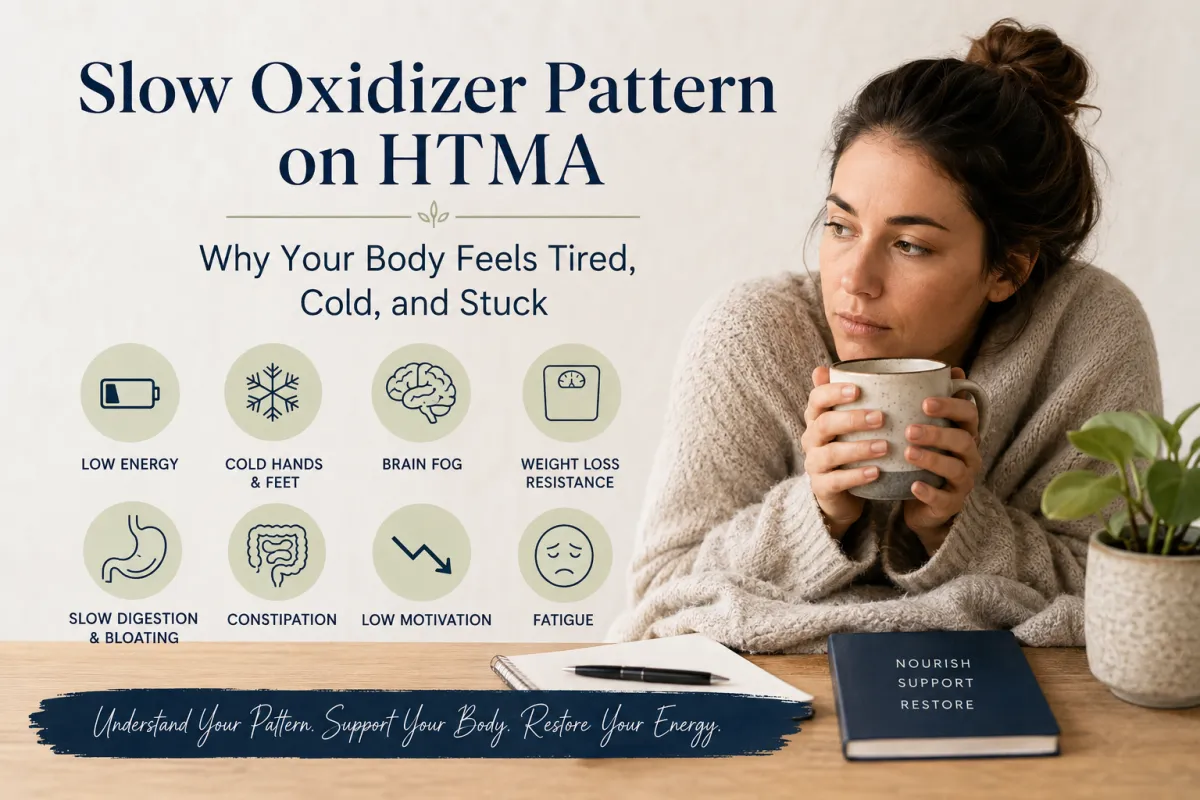
Slow Oxidizer Pattern on HTMA: Why Your Body Feels Tired, Cold, and Stuck
Your body may have hit the brakes
A slow oxidizer pattern on an HTMA can feel incredibly validating when it is explained in plain language.
Because if you are a slow oxidizer, you may have spent years feeling like your body just will not respond the way it should.
You may say things like:
“My metabolism feels stuck.”
“I gain weight easily, but losing it feels impossible.”
“I wake up tired and need a long time to get going.”
“My digestion feels slow.”
“I feel cold, puffy, heavy, or sluggish.”
“I crave sugar or caffeine just to get through the day.”
“I am doing the right things, but my body is not changing.”
A slow oxidizer often feels like they are putting in effort, but the return on that effort is low.
It can feel like driving with the emergency brake on.
You are moving, but everything takes more energy than it should.
This pattern does not mean your body is broken. It usually means your body has shifted into a slower, more protective, energy-conserving state.
Your body is not being lazy.
It may be conserving energy because it does not feel safe enough or supplied enough to spend it freely.
Educational note: HTMA does not diagnose disease. It is a tool that helps us understand mineral patterns, stress response, detox capacity, and how the body may be adapting over time.
What is a slow oxidizer on HTMA?
In HTMA language, a slow oxidizer is someone whose body appears to be burning fuel at a slower-than-ideal rate.
Oxidation simply means how your body burns or uses fuel.
A fast oxidizer tends to burn fuel quickly.
A slow oxidizer tends to burn fuel more slowly, conserve energy, and struggle to turn food into steady usable energy.
In classic mineral-balancing interpretation, slow oxidation often shows up when the calcium-to-potassium ratio is elevated and the sodium-to-magnesium ratio is low.
In plain language, calcium and magnesium tend to dominate relative to sodium and potassium.
That matters because sodium and potassium are more connected to adrenal output, cellular energy, and stress response, while calcium and magnesium are more connected to calming, buffering, slowing, and tissue storage patterns.
So a slow oxidizer may have a body that is underpowered, slow to respond, and more likely to conserve than spend.
Curious what your HTMA may be saying about your body?
A Hair Tissue Mineral Analysis can help us look at your mineral patterns, stress response, adrenal minerals, thyroid expression, digestion, and why your body may feel stuck.
The best analogy: your body is in energy-saving mode
Think about your phone.
When the battery gets low, the screen dims, background apps slow down, and the phone starts conserving power.
It is not broken.
It is protecting the battery.
That is often what a slow oxidizer body is doing.
Your body may dim certain functions so it can keep the basics going.
That can look like:
lower body temperature
slower digestion
lower motivation
heavier mood
slower detox
low libido
weight loss resistance
fatigue after meals
less resilience to stress
lower exercise tolerance
The goal is not to yell at the body to speed up.
The goal is to rebuild the minerals, digestion, blood sugar rhythm, and nervous system safety that allow the body to feel safe enough to come out of conservation mode.
How a slow oxidizer can feel physically
A slow oxidizer may feel:
tired on waking
cold hands and feet
low body temperature
brain fog
constipation
bloating
sluggish digestion
weight loss resistance
dry skin
low libido
low motivation
muscle stiffness
puffy or fluid-retentive
heavy after meals
slow to recover from exercise
This is often the person who feels like their body is moving through mud.
Everything works, but nothing feels efficient.
How a slow oxidizer can feel emotionally
The emotional side is just as important.
A slow oxidizer may feel:
flat
discouraged
foggy
unmotivated
emotionally heavy
easily overwhelmed
less resilient
withdrawn
guilty for not keeping up
frustrated because they are trying so hard
This is not weakness.
Emotional regulation takes energy.
Motivation takes energy.
Patience takes energy.
Healing takes energy.
When the body is conserving energy, those emotional resources can feel harder to access.
If your body feels like it has hit the brakes, your HTMA may help explain why.
A slow oxidizer pattern can give us insight into your mineral balance, thyroid expression, adrenal reserve, digestion, and why your metabolism may feel stuck even when you are trying hard.
The four big minerals in slow oxidation
The first four major minerals on the HTMA, calcium, magnesium, sodium, and potassium, tell us so much about how your body is running.
In a classic slow oxidizer pattern, calcium and magnesium are often higher relative to sodium and potassium.
But this is important: high hair calcium and magnesium do not always mean strong calcium and magnesium status.
They can sometimes reflect poor utilization, buffering, shelling, loss, or minerals sitting in the wrong place rather than being used well inside the cell.
We always read the full pattern, symptoms, ratios, stress history, digestion, food intake, supplements, toxic metals, and how the person actually feels.
When calcium is high in a slow oxidizer
High calcium in a slow oxidizer often feels like the body has built a protective wall.
This is sometimes described as a calcium shell or a calcium buffering pattern.
Calcium is calming and stabilizing, but when calcium is high on the hair test, it may suggest the body is not using or directing calcium well.
Physically, this can show up as:
fatigue
stiffness
constipation
cold hands and feet
slow metabolism
weight loss resistance
joint aches
sluggish digestion
brain fog
low motivation
Emotionally, high calcium can feel like a protective freeze state.
You may feel flat, guarded, apathetic, disconnected, overwhelmed, or like you are living behind glass.
Support is not usually about forcing calcium down aggressively. It is about helping the body use minerals better through digestion, bile flow, thyroid expression, adrenal minerals, vitamin cofactors, gentle movement, and mineral direction.
The goal is not to punish the calcium pattern.
The goal is to help your body feel safe enough to stop hiding behind it.
When magnesium is high in a slow oxidizer
High magnesium in a slow oxidizer can be tricky.
Magnesium is usually thought of as calming and beneficial, but high hair magnesium does not always mean the body has plenty of usable magnesium.
In a slow, depleted, low-sodium pattern, high magnesium can sometimes reflect poor retention, poor utilization, loss, or a body that is spilling magnesium instead of holding it well.
This can feel like:
low muscle tone
weakness
fatigue
poor exercise recovery
constipation
low blood pressure tendencies
low drive
trouble getting motivated
Emotionally, this can feel like resignation.
Not necessarily panic, more like:
“I just do not have it in me.”
Support is about improving retention and utilization, not just adding more and more magnesium.
Some people do well with moderate magnesium, but deeper slow oxidizers may feel worse with too much if sodium and potassium are low. That is why the full pattern matters.
When sodium is low in a slow oxidizer
Low sodium is one of the biggest clues that the adrenal side of the stress response may be underpowered.
Sodium gives us insight into adrenal output, hydration, blood pressure tendencies, and the body’s ability to mount a response.
When sodium is low, you may feel like your body cannot hold a charge.
This can show up as:
low stamina
low blood pressure tendencies
dizziness when standing
salt cravings
poor morning energy
afternoon crashes
weak digestion
poor stress tolerance
feeling worse with fasting
feeling depleted after workouts
needing caffeine but crashing later
Emotionally, low sodium can feel like low resilience.
You may feel like everything is too much. Not because you are weak, but because the mineral charge behind your stress response is low.
Support often starts with steady meals, mineral-rich hydration, appropriate salt support, potassium balance, adrenal nourishment, and not asking the body to perform from an empty tank.
When potassium is low in a slow oxidizer
Potassium is deeply connected to cellular energy, blood sugar rhythm, muscle function, and nervous system steadiness.
When potassium is low, the body may feel wobbly.
This can show up as:
blood sugar dips
shakiness if meals are delayed
sugar cravings
afternoon crashes
muscle weakness
poor workout recovery
constipation
heart flutters or palpitations
waking in the night
anxiety when underfed
feeling better after eating
Emotionally, low potassium can feel like instability.
You may feel tearful, easily overwhelmed, irritable, or less able to regulate when tired, hungry, stressed, or under-fueled.
Support often includes potassium-rich foods when tolerated, balanced carbohydrates, protein with meals, mineral support, blood sugar stability, and avoiding extremes like long fasting, very low-carb dieting, and hard training without enough fuel.
Why slow oxidizers can feel tired, cold, and stuck
Slow oxidizers often show signs that thyroid expression may be low at the cellular level.
This is sometimes called a functional hypothyroid pattern.
That does not mean your thyroid labs are always abnormal.
A person can have thyroid labs that look normal and still feel slow at the tissue level because minerals affect how thyroid hormone is converted, transported, received, and used.
This may feel like:
cold hands and feet
low body temperature
constipation
dry skin
thinning hair
brain fog
low mood
weight loss resistance
low motivation
slower pulse tendencies
feeling like your body will not “turn on”
It is like the thermostat is turned down.
The body is still running, but not warmly, efficiently, or with strong output.
This is why the plan cannot be only “eat less and exercise more.”
A slow oxidizer body often needs to rebuild metabolic signal, digestion, adrenal minerals, and cellular energy before weight loss or higher output feels safe.
Digestion: why food may feel heavy
Slow oxidizers often struggle with digestion because digestion requires energy.
You need energy to make stomach acid, enzymes, bile, and healthy motility.
When the body is in a slower pattern, digestion can become sluggish too.
This may show up as:
bloating
constipation
reflux
burping
feeling full quickly
nausea
low appetite
heaviness after meals
undigested food
food sensitivities
feeling better when not eating
This does not mean food is the enemy.
It may mean your body needs help breaking food down and absorbing minerals well.
For slow oxidizers, digestion is often one of the first foundations to support because if you are not absorbing, you cannot rebuild minerals well.
Support may include eating in a calmer state, chewing well, warm cooked foods, protein that is easy to digest, digestive enzymes or bitters when appropriate, bowel rhythm support, and not overwhelming the gut with huge meals or huge supplement stacks.
This is why I do not look at symptoms in isolation.
Fatigue, bloating, constipation, weight loss resistance, cold hands and feet, and low motivation can all connect back to the same mineral pattern. HTMA helps us see the bigger picture instead of chasing one symptom at a time.
Blood sugar: why sweets and caffeine feel necessary
Many slow oxidizers crave sugar or caffeine because they are trying to create energy quickly.
Sugar gives a quick lift.
Caffeine gives a quick push.
But both can borrow energy from tomorrow.
A slow oxidizer may feel better for a short window, then crash, crave more, feel shaky, or become more anxious and depleted.
Blood sugar support is not about willpower.
It is about giving the body steady fuel so it does not have to keep emergency-signaling for quick energy.
Support may include protein at breakfast, not skipping meals, reducing long fasting windows, pairing carbs with protein and fat, using mineral-rich hydration, and choosing carbs that support steadiness rather than quick spikes.
Why weight loss can feel so hard
Slow oxidizers often carry deep frustration around weight.
They may eat less, exercise more, cut carbs, fast, track everything, and still feel stuck.
This can be especially upsetting because they may feel like their body is not reflecting their effort.
But in a slow oxidation pattern, the body may not feel safe enough to spend energy freely.
If thyroid expression is low, adrenal reserve is low, digestion is sluggish, blood sugar is unstable, and inflammation or copper dysregulation is present, the body may hold on.
This is not a willpower issue.
It is a safety and energy issue.
The body does not easily release when it feels underfed, overstressed, under-mineralized, constipated, inflamed, or depleted.
So the first goal is not always fat loss.
The first goal is metabolic trust.
When the body starts to feel safer, warmer, better fueled, better digested, and better mineralized, body composition work becomes much more realistic.
This is why I do not start with punishment-based weight loss plans.
If your body is conserving energy, eating less and training harder may not be the answer. First, we look at what your body needs to feel safe enough to make energy, digest well, regulate blood sugar, and release the brakes.
Copper and the slow oxidizer pattern
Copper dysregulation is common in slow oxidation frameworks, but it does not always show up as high copper on the HTMA.
Copper can be high, low, hidden, unavailable, or poorly transported.
That is why we do not interpret copper from one number alone.
We look at copper itself, zinc-to-copper, copper-to-molybdenum, calcium, potassium, sodium-to-potassium, symptoms, hormone history, histamine signs, thyroid signs, stress reserve, and toxic metals.
Copper imbalance can overlap with:
anxiety
depression
PMS
estrogen sensitivity
heavy periods
fibroid or endometriosis tendencies
histamine symptoms
headaches
brain fog
skin issues
food reactions
low motivation
thyroid drag
In slow oxidizers, I usually think regulation before aggression.
We do not want to push copper wildly, and we do not want to slam high-dose zinc without context either.
The goal is to improve copper handling: digestion, liver flow, adrenal minerals, trace mineral balance, vitamin A status, protein status, and the cofactors that help copper move and be used properly.
Detox in a slow oxidizer: why pushing can backfire
Slow oxidizers may have toxic metals or stored burdens, but they often do not have the energy to detox aggressively at first.
Detox takes minerals.
Detox takes bile flow.
Detox takes bowel movements.
Detox takes protein.
Detox takes adrenal reserve.
If a slow oxidizer pushes too hard with intense sauna, fasting, aggressive binders, extreme cleanses, hard workouts, or heavy supplement protocols, symptoms may flare.
This can feel like:
headaches
nausea
constipation
anxiety
insomnia
fatigue
skin flares
histamine reactions
body aches
emotional crashes
feeling worse instead of better
That does not mean detox is bad.
It means the order matters.
In Phase 1, we usually want to open drainage before mobilization.
Bowels, hydration, minerals, digestion, sleep, gentle movement, and blood sugar rhythm come first.
A slow oxidizer body usually detoxes better when it feels nourished, not forced.
Phase 1 support for a slow oxidizer
Phase 1 is about gently helping the body come out of conservation mode.
Not shocking it.
Not punishing it.
Not forcing it.
The goal is to help the body feel safe enough to start making and spending energy again.
1. Protein at regular meals
Slow oxidizers often need steady protein to support blood sugar, adrenal rhythm, thyroid expression, detox pathways, tissue repair, and mineral transport.
This does not mean giant portions or forcing foods you cannot digest.
It means consistent, digestible protein at meals.
2. Mineral-rich hydration
Sodium and potassium support can be key, especially when adrenal minerals are low.
This may include mineral salt, electrolytes, broths, potassium-rich foods, and hydration that helps the body hold fluid rather than just flushing through.
3. Digestive support
If digestion is slow, we support digestion early.
Chewing, warm foods, digestive enzymes, bitters, bile support, bowel rhythm, and reducing overwhelm at meals can all matter.
4. Blood sugar stability
No long gaps if they lead to crashes.
Protein-forward breakfast.
Balanced meals.
Carbs matched to tolerance.
Less sugar and less caffeine dependence.
5. Nervous system safety
Sleep rhythm, morning light, boundaries, breathwork, gentle movement, rest days, and less pushing through are all part of the mineral plan.
A slow oxidizer body often needs more signals of safety before it is ready for more output.
6. Gentle detox and drainage
Drainage first.
Mobilization second.
Bowels, bile, hydration, minerals, protein, sleep, and gentle sweating when tolerated.
Detox should feel like a steady exhale, not a crash.
A slow oxidizer usually needs rebuilding, not forcing.
HTMA can help identify which foundations need support first, minerals, digestion, adrenal rhythm, thyroid expression, blood sugar, detox drainage, or nervous system safety.
Food guidance for slow oxidizers
Food for slow oxidizers should be steady, warming, mineral-rich, blood-sugar supportive, and digestible.
The goal is to support metabolism without overwhelming digestion.
Foods to emphasize
protein at each meal
eggs, poultry, fish, beef, turkey, lamb, or other tolerated proteins
warm cooked meals
soups, stews, broths, and mineral-rich fluids
cooked vegetables instead of huge raw salads if digestion is weak
moderate complex carbohydrates based on tolerance
root vegetables, squash, potatoes, rice, or oats if tolerated
potassium-rich foods when appropriate
sea salt or mineral salt as appropriate
gentle spices and warming foods if tolerated
Foods and habits to reduce or be careful with
skipping breakfast when depleted
long fasting windows
very low-protein meals
excess sugar
fruit juice and frequent sweets
too much caffeine, especially on an empty stomach
very high-fat meals if digestion is sluggish
alcohol as a stress valve
extreme cleanses or detox diets
huge raw salads if digestion is already weak
under-eating while trying to train hard
The slow oxidizer usually needs nourishment, not restriction.
They need food that says:
“You are safe. You are fed. You can make energy.”
Movement guidance for slow oxidizers
A slow oxidizer can absolutely benefit from movement.
But the type, dose, and timing matter.
If you train harder than your body can recover from, exercise becomes another stressor instead of a builder.
In Phase 1, the goal is often to build capacity, not prove toughness.
Helpful options may include:
walking
mobility
gentle cycling
lighter strength training
more rest between sets
shorter sessions
slow progressive overload when ready
restorative movement on low-energy days
Be careful with:
excessive HIIT
fasted workouts
long intense cardio
training through exhaustion
very low-calorie dieting with hard exercise
using caffeine to force performance
A helpful question is:
“Do I feel better after this workout, or did it empty me out?”
If it empties you out for days, the workout was too expensive for your current mineral budget.
We can build that budget.
But first, we have to stop spending more than the body can recover.
Frequently asked questions about slow oxidation
Is slow oxidation the same as hypothyroidism?
No. HTMA does not diagnose hypothyroidism. But a slow oxidizer pattern may suggest lower thyroid expression at the tissue level, which can overlap with symptoms like cold hands and feet, constipation, fatigue, brain fog, and weight loss resistance.
Why do slow oxidizers struggle with digestion?
Digestion requires energy. When the body is conserving energy, stomach acid, enzymes, bile flow, and motility may be weaker. That can contribute to bloating, constipation, reflux, and poor absorption.
Should slow oxidizers fast?
Some may tolerate fasting, but many depleted slow oxidizers do worse with long fasting windows because it can increase stress on the adrenals and blood sugar system. The full pattern and symptoms matter.
Why do slow oxidizers crave caffeine and sugar?
Often because the body is looking for quick energy. Caffeine and sugar can create a temporary lift, but they may also contribute to crashes, cravings, anxiety, and deeper depletion if the foundation is not supported.
Can a slow oxidizer pattern improve?
Yes. Slow oxidation can shift with consistent support around minerals, digestion, food rhythm, sleep, movement, adrenal support, and nervous system safety.
The encouragement I want you to hear
If your HTMA shows a slow oxidizer pattern, I do not want you to see it as a label that limits you.
I want you to see it as a map.
It helps explain why your body may feel slow, cold, tired, puffy, foggy, constipated, reactive, or resistant to weight loss.
It helps explain why fasting, under-eating, overtraining, caffeine, and aggressive detox may not work for you right now.
It helps explain why “just push harder” has probably made you feel worse.
Your body is not failing.
Your body is conserving.
And when we support the deeper reason it is conserving, we give it a reason to come back online.
Not by force.
By nourishment.
Not by punishment.
By support.
Not by trying to become someone else’s body.
By finally meeting your body where it is.
Ready to understand your mineral pattern?
If you feel tired, cold, sluggish, stuck, bloated, or frustrated with your metabolism, your HTMA may help connect the dots.
When we work together, we look at your minerals, symptoms, digestion, hormones, workouts, sleep, stress, and real life, because your body is not a collection of random symptoms.
Ready to understand why your body feels stuck?
A slow oxidizer pattern may explain why your body feels tired, cold, sluggish, bloated, or resistant to change. HTMA helps us look at the bigger picture so we can build a plan that supports your body in the phase it is actually in.
The information on this website is for educational purposes only and is not intended to diagnose, treat, cure, or prevent any disease. HTMA is one tool used to understand mineral patterns and how the body may be adapting. Always consult your qualified healthcare provider for medical concerns, diagnoses, medications, or urgent symptoms.